

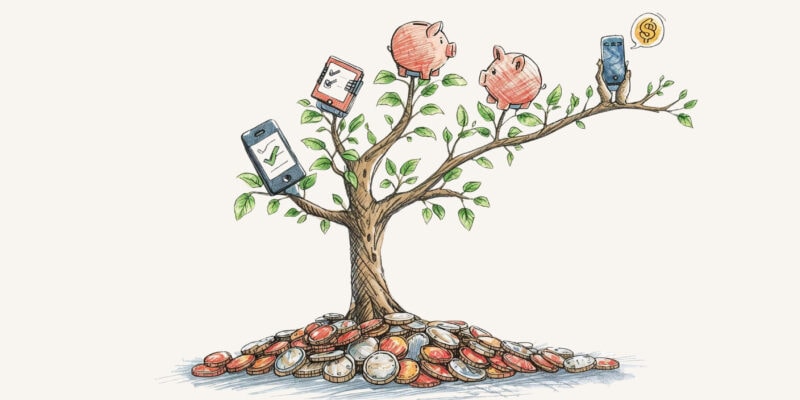
Inflation eats your paycheck before the week is over. Groceries cost more, bills keep rising, and saving feels impossible.
As a CFP®, I’ve worked with clients, dug into the research, and tested countless strategies myself. What I’ve found is surprising: tiny money habits consistently outperform dramatic budget overhauls.
Below are five tiny money habits, most of which you can set and forget, that deliver results without willpower and, most importantly, help you finally feel in control of your money.
1. Know Where Your Money Is Going
Ever feel like your paycheck disappears, and you can’t quite explain where it went?
In The Millionaire Next Door, researchers spent 20 years studying ordinary millionaires — not the flashy kind, but people who quietly built wealth. What they all had in common was simple: they knew exactly where their money was going.
Sure, there’s a time and place for detailed budgeting — like Grandma’s envelope system.
But here’s the truth: if you’re already spending less than you earn, just knowing your key numbers — what comes in and what goes out — gets you 80% of the way there.
When that book was written, tracking meant balancing checkbooks and saving receipts in shoeboxes. Today, apps do it automatically.
You only need to know two things: how much you earn and how much you spend. You’d be surprised how many people can’t answer those questions.
But once you can, everything changes.
You start noticing where your money leaks away. You catch the subscriptions you forgot about. You see which expenses actually matter — and which don’t. You make decisions from awareness, not guesswork.
Want an easier way to see where your money is going? Read our guide to the best budgeting apps. They do the tracking for you.
2. Create a “To Buy” List
Impulse buys feel amazing in the moment, until the bill arrives.
That little dopamine hit from clicking “Add to Cart” is real. Psychologists have found that your brain lights up with pleasure before you even own the item.
It’s not bad to want something or to click “Add to Cart.” But if you’ve ever looked at a purchase a week later and wondered, “Why did I buy this?” you’re not alone. Many people try to stop spending money through willpower alone, but there’s a better way.
The trick isn’t saying “never.” It’s saying, “not right now.”
In one study, people who told themselves they could eat cake later actually ate less than those who tried to forbid it completely. The same principle applies to money. When you postpone instead of deny, you ease the craving without giving in—and that’s where a simple “To Buy” list comes in.
Use the notes app on your phone, a small notebook, or your Amazon wish list. Whenever you feel the urge to buy, write it down and set a reminder to revisit it in seven to thirty days. Most of the time, the desire fades.
The shirt that felt like a must-have today looks less exciting next week. The gadget that seemed life-changing feels unnecessary a month later. You start noticing patterns and finding small ways to save more money without feeling deprived.
And when you do decide to buy, it’s because it truly matters to you—not because of a momentary craving. Sometimes you’ll still want the thing after waiting, and that’s okay. If you’re spending less than you earn, enjoy it.
Being frugal isn’t about deprivation. It’s about aligning your spending with what you actually value. When you buy intentionally, your money stretches further—and you create room to make real financial progress.
3. Turn Everyday Spending Into a Lifelong Investing Habit
The hardest part about investing is starting.
I’ve watched thousands of people say, “I’ll start next year when I have more money,” only to say the same thing years later. It’s not that they don’t want to invest — it’s that they don’t believe small amounts make a difference.
Meanwhile, apps like Acorns have helped over 14 million people prove otherwise, quietly turning spare change into more than $25 billion in long-term wealth.
Nobody feels truly ready to invest. Ever. But the people who dive in anyway, even with just a few dollars, are the ones who actually build wealth.
That’s why I love Acorns. It rounds up your purchases — a $2.40 coffee becomes 60¢ invested — and lets you add automatic deposits as small as $5 a month.
After more than a decade as a financial planner, I’ve seen it again and again: people who start investing $5 today are far more likely to invest $500 later. The ones who wait for “the right time” almost never do.
Here’s my challenge. Start with $5 this month, then increase it by $5 each month. In a year, you’ll be investing $60 monthly. In five years, $300. That’s how lifelong wealth habits grow — one small increase at a time.
If you’re not sure where to begin, Acorns builds diversified portfolios for you based on your goals and comfort level. Saving for an emergency fund? You’ll get a conservative mix. Planning for retirement? You’ll get a long-term portfolio designed by experts.
Set up your first $5 deposit today and Acorns will add a limited-time $20 bonus. It’s $20 for investing just $5 — proof that real wealth starts with a single habit.
Start building wealth automatically with Acorns.
4. Master The Art of Hiding Money from Yourself
One of the easiest and most effective ways to build wealth is to make your money harder to touch.
Why? Because out of sight really is out of mind. And when it comes to saving, that’s a good thing.
When you automatically move small amounts of money out of your checking account before you even see it, you remove the daily decision of “should I save or spend?” That lack of choice works in your favor. Over time, those invisible deposits quietly grow into meaningful savings.
Saving doesn’t have to feel like a sacrifice. The key is to make it automatic, consistent, and almost invisible — a system that aligns with your financial goals.
Here are a few simple ways to put your finances on autopilot:
1. Use your 401(k)’s auto-escalation feature. If your employer offers it, turn on auto-escalation so your contributions automatically increase each year—usually by one percent. It’s most effective when timed with a raise, since you won’t feel the difference in your paycheck. If your plan doesn’t include this option, set a calendar reminder every six months to log in and bump your contribution manually. A one-percent increase twice a year adds up to a 10 percent higher savings rate in just five years.
2. Automate your loan payments and add a little extra. Set your credit card, car loan, or mortgage payments to autopay, then round up each payment by $10 or $20. It might not sound like much, but it shortens payoff time and saves significant interest—without requiring you to think about it again.
3. Keep your savings in a separate bank. Store your emergency fund or long-term savings at a different bank from your everyday checking account. The extra transfer step adds just enough friction to protect your savings from impulse spending. You can even pair this with a reverse budget approach—automating savings first and living on what’s left.
These strategies work because they remove decision fatigue. When the smart choice happens automatically, you stay consistent without relying on willpower.
In other words, you’re paying your future self first. Start small, stay consistent, and you’ll build lasting financial security—often without feeling like you’re giving anything up today. For more ideas, see our guide on how to manage your money or explore the best micro-investing apps to begin automating your growth.
5. A Tiny Frugal Habit That Pays You Back Automatically
As you start to automate more areas of your financial life, saving money naturally becomes part of your daily routine. It’s no longer about cutting corners — it’s about setting up smart systems that quietly work in the background.
One of the tiniest, easiest systems you can put in place is using a free cash-back site like Rakuten.
Rakuten partners with thousands of major retailers — from Target and Walmart to Expedia and Best Buy — and gives you cash back on everyday purchases you’d make anyway. Once you create a free account, you can install their browser extension or mobile app, and Rakuten automatically finds cash-back opportunities whenever you shop.
It’s the definition of a low-effort win. One member of The Ways To Wealth team has earned more than $700 in cash back since 2020 — simply by letting Rakuten run in the background while shopping online.
Right now, Rakuten is offering a $50 welcome bonus when you make your first qualifying purchase within 90 days of signing up — perfect timing for the holiday season. If you haven’t grabbed this bonus yet, it’s one of the easiest ways to start saving automatically.
Cash back is paid quarterly via PayPal or direct deposit, and American Express cardholders can even choose to receive Membership Rewards points instead.
Think of Rakuten as a “tiny frugal habit” that complements the rest of your financial automation — a simple system that saves you money without asking you to change your lifestyle.
Start earning cash back with Rakuten and get your $50 bonus.
Optional Habit #1: Take Three Quick Surveys A Day
By completing a few short surveys each day on your phone, you could earn up to $150 a month — enough to cover life’s little wants without swiping your credit card.
That’s exactly what Branded Surveys was built for.
You can download the app today and start earning whenever you have a free moment — during your lunch break, waiting in line, or scrolling before bed. Each quick survey pays up to $5, and those earnings can add up to real money over time.
Branded Surveys is free to join, and no phone number or address is required. They’ve already paid out over $64 million, with a 4.2-star Trustpilot rating and thousands of daily payouts.
It’s one of the easiest ways to turn idle moments into extra income.
For a limited time, new users who register via The Ways To Wealth get an exclusive 100-point welcome bonus.
Try Branded Surveys + Claim Bonus.